Twelve: The LORD Promises to Bless Jerusalem - Zech 8: 1-23
Updated: Jan 23, 2025
The word of the LORD Almighty came to me.
2 This is what the LORD Almighty says: “I am very jealous for Zion; I am burning with jealousy for her.”
3 This is what the LORD says: “I will return to Zion and dwell in Jerusalem. Then Jerusalem will be called the Faithful City, and the mountain of the LORD Almighty will be called the Holy Mountain.”
4 This is what the LORD Almighty says: “Once again men and women of ripe old age will sit in the streets of Jerusalem, each of them with cane in hand because of their age. 5 The city streets will be filled with boys and girls playing there.”
6 This is what the LORD Almighty says: “It may seem marvellous to the remnant of this people at that time, but will it seem marvellous to me?” declares the LORD Almighty.
7 This is what the LORD Almighty says: “I will save my people from the countries of the east and the west. 8 I will bring them back to live in Jerusalem; they will be my people, and I will be faithful and righteous to them as their God.”
9 This is what the LORD Almighty says: “Now hear these words, ‘Let your hands be strong so that the temple may be built.’ This is also what the prophets said who were present when the foundation was laid for the house of the LORD Almighty. 10 Before that time there were no wages for people or hire for animals. No one could go about their business safely because of their enemies, since I had turned everyone against their neighbour. 11 But now I will not deal with the remnant of this people as I did in the past,” declares the LORD Almighty.
12 “The seed will grow well, the vine will yield its fruit, the ground will produce its crops, and the heavens will drop their dew. I will give all these things as an inheritance to the remnant of this people. 13 Just as you, Judah and Israel, have been a curse among the nations, so I will save you, and you will be a blessing. Do not be afraid, but let your hands be strong.”
14 This is what the LORD Almighty says: “Just as I had determined to bring disaster on you and showed no pity when your ancestors angered me,” says the LORD Almighty, 15 “so now I have determined to do good again to Jerusalem and Judah. Do not be afraid. 16 These are the things you are to do: Speak the truth to each other, and render true and sound judgment in your courts; 17 do not plot evil against each other, and do not love to swear falsely. I hate all this,” declares the LORD.
18 The word of the LORD Almighty came to me.
19 This is what the LORD Almighty says: “The fasts of the fourth, fifth, seventh and tenth months will become joyful and glad occasions and happy festivals for Judah. Therefore love truth and peace.”
20 This is what the LORD Almighty says: “Many peoples and the inhabitants of many cities will yet come, 21 and the inhabitants of one city will go to another and say, ‘Let us go at once to entreat the LORD and seek the LORD Almighty. I myself am going.’ 22 And many peoples and powerful nations will come to Jerusalem to seek the LORD Almighty and to entreat him.”
23 This is what the LORD Almighty says: “In those days ten people from all languages and nations will take firm hold of one Jew by the hem of his robe and say, ‘Let us go with you, because we have heard that God is with you.’”
Ringing church bells requires a surprisingly high degree of skill, involving concentration, physical strength, timing and good teamwork. For a tower of eight bells to ring a complete ‘peal’, in which every possible permutation is sounded in turn, the ringers have to continue without a pause for as long as three hours. In the hands of skilled ringers the effect is almost magical. When the less-skilled are having a go, it sounds (to use my dad’s memorable phrase) like a load of scaffolding poles falling off a lorry.
In the church of All Saints, Barmston, on the east coast of Yorkshire, there is but a single bell. It still takes a degree of skill (which I don’t possess) to get a single note out of it, but even in the hands of a skilled ringer a single note is its limit. The tolling note sounds out over the flat countryside around, calling the faithful to worship. Its slightly mournful tone makes it ideal for a funeral and not too bad for an early morning Communion, but it’s hard to get it to sound just right for a wedding.
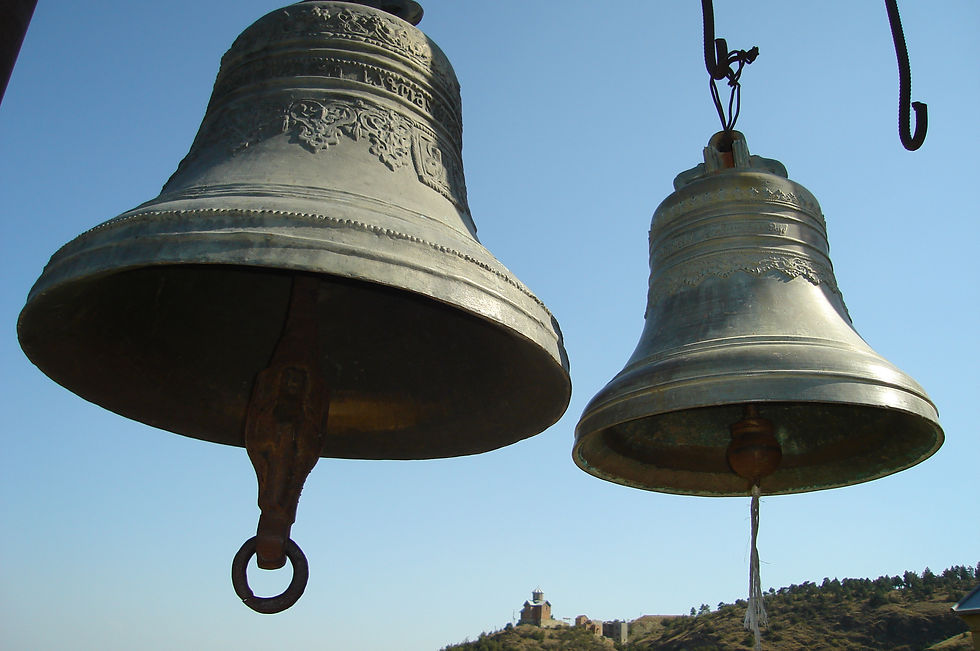
This passage, Zechariah 8, is like a single bell tolling, but it’s for a wedding not a funeral, joy not despair.
Let’s work up to it. In the last chapter we read how a delegation of men with impressive-sounding names have come from Bethel (or perhaps Babylon) to Jerusalem to ask if they should keep on fasting in the fifth month, as they have done for many years. The fast has been to commemorate the destruction of Jerusalem, about 70 years earlier. Instead of answering their question, Zechariah launches a blistering attack on them, in the name of the Lord. “When you fasted and mourned… was it really for me that you fasted?” (7:5).
No, you did it for your own benefit, not mine! You’re in danger of being like your forefathers, who were sent into exile for their stubborn disobedience, leaving the pleasant land desolate behind them.
I can imagine Zechariah left exhausted by that tirade. It must cost a prophet dearly, I think, to speak God’s words, especially words of judgement. We hear how actors feel quite ‘spent’ after an emotional performance, and need a while to unwind. I’m guessing it’s like that, but ten times worse.
Maybe Zechariah continued to feel unsettled, his troubled thoughts turning to prayer. “Is this how it’s going to be, Lord? A cycle of disobedience, punishment, partial repentance, then disobedience all over again? Will there ever be an end? Do you even love us any more?”
Then the word of the Lord Almighty comes again to Zechariah – not once, but again and again. Ten times in this chapter we have ‘This is what the Lord Almighty says’. In older translations it’s ‘Thus says the Lord.’ Again and again, like a deep bell tolling, thundering out its message. And with each toll, a picture in words, adding layer upon layer, making up a composite picture of blessing and love and renewal.
‘Thus says the Lord (v2): I am burning with jealousy for Zion.’ These are the words, not of a strict master, but a passionate lover. He won’t give up on Jerusalem, and he won’t settle for anything less than passion in return.
The bell tolls again. ‘Thus says the Lord’ (v3): I will return, and Jerusalem will have a new name – City of Truth; Mountain of Holiness.
The scholars Grace Emmerson and P R Ackroyd point out that Zion or Jerusalem is given a new name in a number of places in the OT. Here (v3) it is ‘City of Truth’ and ‘Holy Mountain’; in Is 62:4 it is ‘Hephzibah’ (My Delight is in Her) and ‘Beulah’ (Married) rather than ‘Deserted’ and ‘Desolate’; and in Ezek 48:35 it is ‘The Lord is There’.
Another ring of the bell. ‘Thus says the Lord almighty’ (v4-5): once again the streets will be full of old people sitting in the shade and children playing. Think of those news pictures of the bomb-devastated regions of Syria, Gaza or Yemen. No one dares go outdoors, unless they’re fleeing for their lives. Very few make it to old age. Here instead is a picture of peace and restoration – the old and the young out in the streets, and there’s no one to harm them. You might think that sounds impossible, says God in v6 after another ‘Thus says the Lord’, but nothing is impossible for me!
The commentator Elizabeth Achtemeier writes (p137), “When we think to join cause with God’s purpose for his earth, we need ask ourselves if we are constructing a place where little children may play. Perhaps [former] Prime Minister Golda Meier fleetingly caught that vision when she welcomed Anwar Sadat of Egypt on his historic peace-mission to Israel [this was in Nov 1977], not with the silver bowl or other art object so often exchanged between heads of state but with a simple present for his grandchildren.”
The bell tolls again. ‘Thus says the Lord almighty’ (v7-8): I will bring my people back, from east and west. They will know me to be faithful and righteous.
We see how the picture is building up – a loving, faithful God, a returning people, a peaceful city.
Hear the bell ring again. ‘Thus says the Lord almighty’ (v9-13): you have known real hardship – poverty, harassment and being under a curse. But now poverty will be replaced by abundance. Harassment by security. And instead of being a curse-word, you will be a blessing. So strengthen your hands, and let’s finish the rebuilding of the Temple, so I may live among you again.
There is some uncertainty surrounding v9. The foundation of the new Temple had been laid some 20 years previously by the governor Zerubbabel, well before Haggai and Zechariah were on the scene. If v9 refers to that event, the prophets it mentions must have been other people, now unknown to us. Alternatively, it could refer to the time, just two years previously, when the building work had restarted under the instigation of Haggai and Zechariah. These would be the prophets of v9, but to say it was the day when the house of Lord was ‘founded’ is a bit of a stretch.
The bell tolls again. ‘Thus says the Lord almighty’ (v14-17): just as I was against you in the past, from now on I’m going to be for you. So please me in the way you live – speak the truth, judge fairly, don’t plot evil, and avoid deception – I hate all that sort of thing.
The commentator Andrew Hill (p200) argues that truth is a sub-theme of this chapter, with the word occurring four times in v3, v8 (where the NIV renders it ‘faithful’), v16 and v19. It is possible that v16 lies behind Eph 4: 25, “Therefore each of you must put off falsehood and speak truthfully to his neighbour…,” showing that God’s insistence on the importance of truth-telling has not changed.
The picture has been built up further. This city of God, full of returning exiles, is prosperous, content and just.
The bell tolls again. ‘Thus says the Lord Almighty’ (v18-19): that fast you were asking about – in fact all the fasts – let’s make them feasts instead! There is no longer any need to mourn for the destruction of Jerusalem. Let’s rejoice instead in what God has taught us, yes even in his discipline, for now he shows us a smiling face.
The fasts appear to build up, from the one in the visitors’ question in 7:3, to the two in 7:5, to the four mentioned here in v19. The scholar Pamela Scalise deftly summarises them all (p262): in the fourth month Nebuchadnezzar’s army had broken through the city walls; in the fifth month the Babylonians had destroyed and burned the temple and other buildings; in the seventh month Gedaliah the governor had been assassinated; and the whole catastrophe had begun in the tenth month, a year or two earlier, when the Babylonian army laid siege to Jerusalem. These were catastrophic events in the life of the nation; it seems a fair question to ask how long they should continue to be mourned, especially in view of the near-completion of the new Temple.
Another ring of the bell. ‘Thus says the Lord almighty’ (v20-22): it’s not just my people, the Jews – it’s every nation, every tongue, every tribe. People will come flooding in, wanting to seek God and live in peace with him. The promise to Abraham in Gen 12:3 that he would be a blessing to all peoples on earth will be fulfilled. There is this lovely, slightly comic picture in v23, after a final bell-toll, of ten people from all languages and nations grabbing tight hold of the edge of the cloak of a single one of God’s people saying, “We’re coming with you, because we have heard that God is with you!”
On v23 the commentator Rex Mason writes (p73), “Not only will [the Jews of the Diaspora] be able to come and share fully in the blessings of the new age, but, because of them, the Gentiles of the lands in which they live shall come also. It is perhaps the nearest to an active missionary concept of the mission of the Jews that occurs in the Old Testament, outside the book of Jonah.”
Isn’t all of that a fabulous picture? It is multi-layered, multi-coloured, beautiful. A city at peace, rebuilt, repopulated, all ages and races at one, living in abundance and peace. Where fasting has become feasting, and the tears of mourning are wiped away.
Surely this is what Jesus meant when he talked about the kingdom of God? A place where God is acknowledged openly as King. Where people live in his way and receive his blessing.
When we look at Jesus, however, we realise that this vision is being fulfilled, not in Jerusalem, but in Him.
God’s passionate love? “This is my beloved Son, with whom I am well pleased.”
The city of truth and mountain of holiness? “I am the way, the truth and the life,” says Jesus.
The elderly at rest and children playing? Think of the sick he healed and the children he blessed.
Abundance, security and blessing? Jesus said, “I have come to bring life in all its fullness.”
A community that speaks the truth, judges fairly and loves one another? Isn’t that what Jesus is building, however imperfect we are at the moment – the church, a community of disparate believers who try to love God and love their neighbour?
And people from every nation and language flocking together to worship God? Again, isn’t this what Jesus has brought about?
You, like me, may have had the privilege of being in a large, multicultural gathering where we’ve all been invited to say the Lord’s Prayer in our own language. Off we all go, with a shared rhythm but unfamiliar words, knowing we’re praying the same prayer, and landing on the universal word ‘Amen’ at about the same time. It’s a spine-tingling experience.
I think Zechariah would have been shaking when finally the bell stopped tolling and this series of God’s utterances was complete. And I can imagine Jesus, reading these words over and over again, realising that it was his unique vocation to make them come true. To inaugurate this blessed kingdom of God in himself.
But he knew it would come at huge cost. Perhaps from reading the later chapters of Zechariah, or Isaiah, or the Psalms, Jesus knew that bringing about the kingdom would take him to the cross.
As we know from Mark 8:34, any of us who wants to walk in Jesus’ footsteps must deny ourselves, take up our own cross and follow him. Costly, yes, but so life-giving! Are we ready for this? Will we join in the great adventure of working for God’s kingdom, bringing about that peaceful, just community God revealed to Zechariah, that he’s building among us now, and will finish at the end of the ages when Christ is finally revealed to all? Do we dare to deny ourselves, take up our cross every day, and follow him?
Can we hear the bell tolling, calling, calling? To give up our small ambitions. Deny. Take up our cross. Follow.
Thus says the Lord.
Thus says the Lord.


Comments