Ten: Coda - A Crown for Joshua - Zech 6: 9-15
- Nov 23, 2024
- 8 min read
9 The word of the LORD came to me: 10 ‘Take silver and gold from the exiles Heldai, Tobijah and Jedaiah, who have arrived from Babylon. Go the same day to the house of Josiah son of Zephaniah. 11 Take the silver and gold and make a crown, and set it on the head of the high priest, Joshua son of Jozadak [Hebrew Jehozadak, a variant of Jozadak]. 12 Tell him this is what the LORD Almighty says: “Here is the man whose name is the Branch, and he will branch out from his place and build the temple of the LORD. 13 It is he who will build the temple of the LORD, and he will be clothed with majesty and will sit and rule on his throne. And he [or there] will be a priest on his throne. And there will be harmony between the two.” 14 The crown will be given to Heldai [Syriac; Hebrew Helem], Tobijah, Jedaiah and Hen [or and the gracious one, the] son of Zephaniah as a memorial in the temple of the LORD. 15 Those who are far away will come and help to build the temple of the LORD, and you will know that the LORD Almighty has sent me to you. This will happen if you diligently obey the LORD your God.’
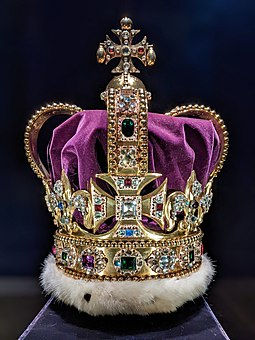
“You join us here in Westminster Abbey as we near the climax of this historic occasion. After so many years of waiting, Prince Charles, now King Charles III, is about to be crowned. The Archbishop of Canterbury stands beside the elderly king, both garbed in splendid robes appropriate to the occasion. St Edward’s Crown, dating back to 1661, stands ready to be placed on the monarch’s head, the only part of this pageant that, by tradition, is not pre-rehearsed.
“The solemn moment has almost arrived. We have interviewed everyone we can possibly think of, including the lady who hoovers the red carpet and the man who cleans up after the horse-drawn carriages. We have heard opinions from nearly everyone, whether they have any specialist knowledge, or just like the sounds of their own voices. We have even had an outside broadcast from a souvenir stall on the Edgware Road, replete with matching Charles and Camilla toothbrushes and a shivering journalist.
“Now, at last, the moment is here. The choir has finished its anthem. The last chord from the trumpets has drifted to the vaulted ceiling. We watch with bated breath as the crown is lifted, reverently, carefully, and placed on the head of… the Archbishop of Canterbury!
“Oh no, what a catastrophe! This is unprecedented. It looks as though the Archbishop is to be our next king. Social media has exploded in a frenzy, and for once I’m speechless. Over to you, Kirsty…”
This is just a silly story. They’d never make that sort of mistake. But something like that is going on in this passage – they crown the high priest instead of the king!
To recap: the place is Jerusalem. The time, about 519 BC. The city had been razed to the ground by the Babylonians and nearly all of the people had been exiled. Now the Persians were in charge, and the exiles were being allowed to return home, in dribs and drabs. The Temple was gradually being rebuilt, after Haggai, Zechariah’s older contemporary, had given the people a prophetic boot up the backside to get on with it. The two local people to reckon with were Zerubbabel the governor (a descendant of King David, but very much under the thumb of the Persian overlords) and Joshua, the High Priest.
This episode is not one of Zechariah’s eight visions but fits comfortably at the end of them, recapitulating themes of priesthood, kingship and the Temple, like the ending of a piece of music. For this reason, I have called the chapter ‘Coda’.
Zechariah’s prophecy comes just as the latest caravan was arriving from afar with returning exiles led by three men, Heldai, Tobijah and Jedaiah. They’d brought back some silver and gold, and God tells Zechariah to take it to the house of Josiah son of Zephaniah (a metal-smith, perhaps) and make it into a crown. (Crowns in those days would have been simple metal circlets, so there’d have been perhaps a gold one and a silver one, maybe linked together in some way or interwoven).
The travellers’ names in v10 and v14 don’t quite match. Heldai in v10 has become Helem in v14 – possibly one is a formal name and the other a nickname, like our ‘James’ and ‘Jim’. The NIV uses Heldai each time, relegating Helem to a footnote.
Likewise, Josiah son of Zephaniah in v10 has become Hen son of Zephaniah in v14. The same explanation might hold good here; alternatively the latter, which means ‘gracious one’, might be a description rather than a nickname.
The clause ‘who have arrived from Babylon’ actually comes right at the end of v10, so it is possible that Joshua (or Hen) was also among the travellers; having a house in Jerusalem he invited the other three to stay with him.
Then Zechariah is told to act out a coronation, as a sign of what God is up to. But he doesn’t crown Zerubbabel the governor, even though he’s a descendant of King David. At God’s command, he crowns Joshua the high priest instead.
Noting the oddness of crowning a high priest, many scholars have concluded that Governor Zerubbabel, descendant of King David, was originally mentioned in the text at this point. A later scribe, noting that Zerubbabel’s line had died out and that the priests had become ever more powerful, put in Joshua’s name instead. There is no manuscript evidence for this, however, and it would have been a bold scribe who made this move.
What is God up to?
Fortunately, he explains. This, he says, is the Branch, the Temple-builder and the King.
First of all, the Branch. Verse 12 begins, “Here is the man whose name is the Branch, and he will branch out from his place…” As explained earlier in Blog number 5, the Branch is a title of Messiah, the promised king-to-come. Both Isaiah and Jeremiah use this title in their prophecies (Is 4:2; 11:1-3; 53:2; Jer 23:5-6; 33:15-18). The old line of kings had been cut down, like a felled tree. But a shoot, a branch, springs up from the stump – and this is the Messiah.
Next to the churchyard gate of St Mary Magdalene, Wyken in Coventry, where I used to be Team Vicar, there stood a large tree which had become dangerous and had to be felled. Nothing remained of the old tree to show what had been there except the stump. But there was plenty of life left in what remained. The next year long shoots were springing up again.
A shoot, a branch, will spring up from the felled stump that is the line of Judah’s kings.
Then God says of newly crowned high priest Joshua that, not only is he a sign of the coming ‘Branch’, but (v13) “It is he who will build the temple of the Lord.” This Branch is a Temple-builder. Now, the Temple was already being built, so it seems that God must be talking about something even greater.
This looks forward to a future Temple which the priest-king would build, a place for God to live, a place, perhaps, not built out of stone or brick, but of living people (see Eph 2:19-22).
When Solomon was dedicating the first Temple, which had taken seven years to build, he exclaimed, “But will God really dwell on earth with humans? The heavens, even the highest heavens, cannot contain you. How much less this temple I have built!” (2 Chron 6:18). Solomon perhaps glimpsed the fact that God would one day find a Temple, a place to dwell, far better than the stone one in Jerusalem.
So God says to this bewildered priest with a crown on his head, I’m pointing towards a Branch, a Temple-builder, and a King. As he says in v13, “He will be clothed with majesty and will sit and rule on his throne.”
The books of 1 and 2 Kings in the OT tell the story of a long line of the kings of Judah’s kings, more or less going from bad to worse, and ending up being dragged into exile. One of them even had his eyes put out. The long lineage ended up being clothed with shame. Now God says that his Branch, the Messiah, the Temple-builder, will be a King clothed with majesty instead.
In v13 God also says “He will be a priest on his throne. And there will be harmony between the two.” At the time of the prophecy there were Zerubbabel the governor and Joshua the high priest.
This is the case for many states down the ages – executive power in one place, religious power in another. (And when they are joined, there is usually an abuse of power!). But God promises a king who will also be a priest, in harmonious unity, acting with justice.
In what is seen as a clear reference to the Messiah, in Ps 110: 4 the Lord swears, “You are a priest for ever, in the order of Melchizedek.” Melchizedek is a mysterious figure who pops up in Gen 14:18-20, blesses Abram, receives a share of his wealth, and vanishes without trace. He is described as “king of Salem [Jerusalem]” and “priest of God Most High” and his name translates as “king of righteousness.” The author of the Letter to the Hebrews makes much of him, referring to him by name no fewer than eight times in Heb 5-7, seeing him as a forerunner of Jesus, not least because he was both king and priest. This is all of a piece with Zechariah’s prophecy of a priest on the throne.
But what should be done with that crown in the meantime? Joshua can’t go around wearing it all day; this is just a symbolic coronation. God says in v14 to put it in the Temple as a memorial – a reminder of this prophecy. Many churches place a poppy wreath in a prominent position on Remembrance Sunday each year as a reminder of suffering long ago and in the recent past. The crown in the Temple, however, was to be a reminder of glories still to come.
The scholar Elizabeth Achtemeier says (p133) that Jesus “now builds the true temple of God from those of every nation (cf Eph 2:17-22; 1 Cor 3:16-17; 2 Cor 6:16); and thus, though Zerubbabel’s temple has been destroyed, the crown that Joshua deposited in it has endured. In some Christian churches, the replica of it is symbolically suspended or emblazoned above the altar table as a sign of the fact that the crown now rests on the head of Jesus Christ.”
Zechariah’s prophecy ends in v15 with a picture of people streaming in from distant lands to help to build – and perhaps to be part of – the new Temple. To be part of the kingdom of the Messiah, the Branch, the Temple-builder, the priestly King.
Commentator Anthony Petterson speculates (p191) that, after Jesus rode into Jerusalem on a donkey, he went to the Temple to receive the crown that had been placed there in the time of Zechariah 550 years before, knowing it was rightfully his. (There is no evidence at all for this, or even that the crown was still there after so many years, but it is an intriguing fancy). Finding the Temple defiled, Jesus made a whip out of cords and cleansed its courts. This was the last straw for Joshua’s successors, the chief priests, who determined to kill the trouble-maker. A few days later Jesus, the king and priest par excellence was indeed crowned.
But it was not with silver and gold.
It was with thorns.


Comments